"Every human protector must wake this way...I've been stupid."
-Larry Niven, Protector (London, 1974), p. 213.
We do not become protectors. However, we learn, mature and continue to learn - by study, training, experience and, possibly, meditation. We can look back and see that we were stupid. We might even realize that we are still stupid much of the time, a problem not experienced by protectors.
The men who become protectors on the colony planet, Home, cooperate to control the planet and to create more protectors for the coming conflict with the attacking Pak. Similarly, in the world reflected by fiction, those who reach a common understanding of Terrestrial problems cooperate with each other - though not with those of different understandings.
We lack the common purpose of a group of species protectors.
Saturday, 12 April 2014
Friday, 11 April 2014
Niven's Collaborations
Larry Niven has collaborated with several other sf writers and franchised one period of his future history to several more. I have ordered from the public library three of Niven's works, each a collaboration with a different other author:
the first part of an sf diptych;
the second part of a fantasy diptych;
the third part of a sf trilogy which is also part of a future history series.
This gets complicated. Fans who have kept up with Niven over the years should recognize the works in question from these descriptions.
Years ago, there was one Ringworld novel in which Louis Wu and his crew visited the Fleet of Worlds en route to the Ringworld. Now, there is a Fleet of Worlds Trilogy and a Ringworld Tetralogy!
On the Poul Anderson Appreciation blog, I have just listed several fictional accounts of visits to Hell, including Inferno and Escape From Hell by Larry Niven and Jerry Pournelle, but have yet to read Escape... so it should be no surprise that that is the second item listed above.
The Ringworld, an inhabited ring encircling a planet, is an artifact bigger than a planet. The Shipstar, an inhabited bowl partially enclosing a star, is an even bigger artifact. I have yet to read about the latter.
the first part of an sf diptych;
the second part of a fantasy diptych;
the third part of a sf trilogy which is also part of a future history series.
This gets complicated. Fans who have kept up with Niven over the years should recognize the works in question from these descriptions.
Years ago, there was one Ringworld novel in which Louis Wu and his crew visited the Fleet of Worlds en route to the Ringworld. Now, there is a Fleet of Worlds Trilogy and a Ringworld Tetralogy!
On the Poul Anderson Appreciation blog, I have just listed several fictional accounts of visits to Hell, including Inferno and Escape From Hell by Larry Niven and Jerry Pournelle, but have yet to read Escape... so it should be no surprise that that is the second item listed above.
The Ringworld, an inhabited ring encircling a planet, is an artifact bigger than a planet. The Shipstar, an inhabited bowl partially enclosing a star, is an even bigger artifact. I have yet to read about the latter.
Wednesday, 12 March 2014
From The Earth To The Sun
Jules Verne's Moon novels are two volumes that should have been one whereas his Hector Servadac is one volume that has been split into two. Human beings would not be able to survive either in a projectile fired from a cannon or on a part of the Earth struck by a comet.
The two Parts of Hector Servadac could appropriately have been entitled From The Earth To The Sun and Around The Solar System. The characters seem to spend nearly all of Part One thinking that they are still on Earth. Until it is explained, the change to their environment is uniquely strange.
The Moon novels spend too much time stating, in a documentary style, what was already known about the Moon and far too little time describing any new discoveries made by the astronauts. They seem to glimpse seas and clouds on the Far Side but do not discuss this before concluding that the Moon was, but no longer is, habitable.
The two Parts of Hector Servadac could appropriately have been entitled From The Earth To The Sun and Around The Solar System. The characters seem to spend nearly all of Part One thinking that they are still on Earth. Until it is explained, the change to their environment is uniquely strange.
The Moon novels spend too much time stating, in a documentary style, what was already known about the Moon and far too little time describing any new discoveries made by the astronauts. They seem to glimpse seas and clouds on the Far Side but do not discuss this before concluding that the Moon was, but no longer is, habitable.
Sunday, 9 March 2014
Hector Servadac
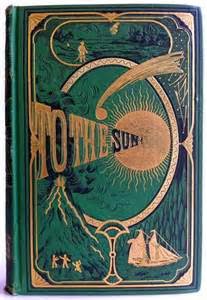
Hector Servadac, one of Jules Verne's fifty four Extraordinary Voyages, was translated into English and published in two volumes as To The Sun and Off On A Comet but is now referred to as Off On A Comet. Thus, when I ordered Off On A Comet from the public library and received To The Sun and Off On A Comet in one volume entitled The Space Novels of Jules Verne, I thought that I was getting the novel that I had requested and another that I had not heard of whereas the one that I had not heard of is simply the first part of the work that I did want and Off On A Comet in a volume to itself would have been only the second half.
While agreeing that Hector Servadac is a deplorable title, I suggest that the original subtitle, "Voyages And Adventures Across The Solar World," might instead serve as an overall title that would both express the contents and convey the scope of this single novel.
Jules Verne's Series
OK. I got it wrong again. See here. Three Jules Verne novels form a trilogy:
From The Earth To The Moon
Around The Moon
The Purchase Of The North Pole
- two form a diptych:
To The Sun?
Off On A Comet
(Later: it transpires that these books are a single novel translated and published in two volumes.)
- two feature Captain Nemo:
Twenty Thousand Leagues Under The Sea
The Mysterious Island
and are connected by other characters to In Search Of The Castaways
- and I suspect that there are other connections between Verne's books of which I am as yet unaware.
Wells' two interplanetary novels follow Verne's and also in the same literary tradition are CS Lewis' Out Of The Silent Planet and Perelandra/Voyage To Venus. The third volume of Lewis' trilogy, That Hideous Strength, continues the tradition because, although it is set entirely on Earth, it places Earth in a Solar context and imparts information about life on the Moon. However, it is mainly a reply to Wells' The Shape Of Things To Come and Olaf Stapledon's Last And First Men because it addresses the question of the social role of science in the future of human civilization on Earth.
From The Earth To The Moon
Around The Moon
The Purchase Of The North Pole
- two form a diptych:
To The Sun?
Off On A Comet
(Later: it transpires that these books are a single novel translated and published in two volumes.)
- two feature Captain Nemo:
Twenty Thousand Leagues Under The Sea
The Mysterious Island
and are connected by other characters to In Search Of The Castaways
- and I suspect that there are other connections between Verne's books of which I am as yet unaware.
Wells' two interplanetary novels follow Verne's and also in the same literary tradition are CS Lewis' Out Of The Silent Planet and Perelandra/Voyage To Venus. The third volume of Lewis' trilogy, That Hideous Strength, continues the tradition because, although it is set entirely on Earth, it places Earth in a Solar context and imparts information about life on the Moon. However, it is mainly a reply to Wells' The Shape Of Things To Come and Olaf Stapledon's Last And First Men because it addresses the question of the social role of science in the future of human civilization on Earth.
Friday, 7 March 2014
Moon, Sun, Comet
I said before that Jules Verne wrote three interplanetary novels but this was wrong. Off On A Comet has come to me from the public library in a double volume with its prequel, starring the same central character, To The Sun? -of which I had never heard.
Thus, it would be possible to publish in uniform editions six classic volumes of interplanetary fiction:
From The Earth To The Moon, Verne
Around The Moon, Verne
To The Sun?, Verne
Off On A Comet, Verne
The First Men In The Moon, Wells
The War Of The Worlds, Wells
I now have three by Verne to read with interest.
Thus, it would be possible to publish in uniform editions six classic volumes of interplanetary fiction:
From The Earth To The Moon, Verne
Around The Moon, Verne
To The Sun?, Verne
Off On A Comet, Verne
The First Men In The Moon, Wells
The War Of The Worlds, Wells
I now have three by Verne to read with interest.
Monday, 3 March 2014
Souls
One familiar sf scenario is a decades-long interstellar voyage with passengers in suspended animation tended either by robots or by a rotating crew. In one of the chronologically confusing chapter-long flashbacks of Use of Weapons (London, 2013), Iain M Banks relocates his protagonist, Zakalwe, as a passenger and temporary crew member on such a voyage. This is another interesting change of scene but I am having trouble pulling the whole narrative together.
Another crew member tells Zakalwe a story. Because his people discussed the question of the soul so much, a philosopher king ordered a global debate after which he withdrew to think, then published two books, one endlessly repeating, "Souls do exist. Souls do not exist," the other endlessly repeating, "Souls do not exist. Souls do exist." (p. 356)
This might be considered either amusing or profound but I saw it as both wasteful and insulting to religious believers, philosophers and psychologists. Banks could better have spent those two pages summarizing the history of the subject, starting with people inferring a soul from the experience of apparently leaving the body while dreaming. I commend the Buddhist anatta teaching but am interested to hear reasoned expressions of other theories or beliefs.
Another crew member tells Zakalwe a story. Because his people discussed the question of the soul so much, a philosopher king ordered a global debate after which he withdrew to think, then published two books, one endlessly repeating, "Souls do exist. Souls do not exist," the other endlessly repeating, "Souls do not exist. Souls do exist." (p. 356)
This might be considered either amusing or profound but I saw it as both wasteful and insulting to religious believers, philosophers and psychologists. Banks could better have spent those two pages summarizing the history of the subject, starting with people inferring a soul from the experience of apparently leaving the body while dreaming. I commend the Buddhist anatta teaching but am interested to hear reasoned expressions of other theories or beliefs.
Subscribe to:
Posts (Atom)