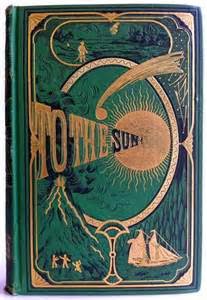
Jules Verne's Moon novels are two volumes that should have been one whereas his Hector Servadac is one volume that has been split into two. Human beings would not be able to survive either in a projectile fired from a cannon or on a part of the Earth struck by a comet.
The two Parts of Hector Servadac could appropriately have been entitled From The Earth To The Sun and Around The Solar System. The characters seem to spend nearly all of Part One thinking that they are still on Earth. Until it is explained, the change to their environment is uniquely strange.
The Moon novels spend too much time stating, in a documentary style, what was already known about the Moon and far too little time describing any new discoveries made by the astronauts. They seem to glimpse seas and clouds on the Far Side but do not discuss this before concluding that the Moon was, but no longer is, habitable.
Showing posts with label Jules Verne. Show all posts
Wednesday, 12 March 2014
Sunday, 9 March 2014
Hector Servadac
Hector Servadac, one of Jules Verne's fifty four Extraordinary Voyages, was translated into English and published in two volumes as To The Sun and Off On A Comet but is now referred to as Off On A Comet. Thus, when I ordered Off On A Comet from the public library and received To The Sun and Off On A Comet in one volume entitled The Space Novels of Jules Verne, I thought that I was getting the novel that I had requested and another that I had not heard of whereas the one that I had not heard of is simply the first part of the work that I did want and Off On A Comet in a volume to itself would have been only the second half.
While agreeing that Hector Servadac is a deplorable title, I suggest that the original subtitle, "Voyages And Adventures Across The Solar World," might instead serve as an overall title that would both express the contents and convey the scope of this single novel.
Jules Verne's Series
OK. I got it wrong again. See here. Three Jules Verne novels form a trilogy:
From The Earth To The Moon
Around The Moon
The Purchase Of The North Pole
- two form a diptych:
To The Sun?
Off On A Comet
(Later: it transpires that these books are a single novel translated and published in two volumes.)
- two feature Captain Nemo:
Twenty Thousand Leagues Under The Sea
The Mysterious Island
and are connected by other characters to In Search Of The Castaways
- and I suspect that there are other connections between Verne's books of which I am as yet unaware.
Wells' two interplanetary novels follow Verne's and also in the same literary tradition are CS Lewis' Out Of The Silent Planet and Perelandra/Voyage To Venus. The third volume of Lewis' trilogy, That Hideous Strength, continues the tradition because, although it is set entirely on Earth, it places Earth in a Solar context and imparts information about life on the Moon. However, it is mainly a reply to Wells' The Shape Of Things To Come and Olaf Stapledon's Last And First Men because it addresses the question of the social role of science in the future of human civilization on Earth.
From The Earth To The Moon
Around The Moon
The Purchase Of The North Pole
- two form a diptych:
To The Sun?
Off On A Comet
(Later: it transpires that these books are a single novel translated and published in two volumes.)
- two feature Captain Nemo:
Twenty Thousand Leagues Under The Sea
The Mysterious Island
and are connected by other characters to In Search Of The Castaways
- and I suspect that there are other connections between Verne's books of which I am as yet unaware.
Wells' two interplanetary novels follow Verne's and also in the same literary tradition are CS Lewis' Out Of The Silent Planet and Perelandra/Voyage To Venus. The third volume of Lewis' trilogy, That Hideous Strength, continues the tradition because, although it is set entirely on Earth, it places Earth in a Solar context and imparts information about life on the Moon. However, it is mainly a reply to Wells' The Shape Of Things To Come and Olaf Stapledon's Last And First Men because it addresses the question of the social role of science in the future of human civilization on Earth.
Friday, 7 March 2014
Moon, Sun, Comet
I said before that Jules Verne wrote three interplanetary novels but this was wrong. Off On A Comet has come to me from the public library in a double volume with its prequel, starring the same central character, To The Sun? -of which I had never heard.
Thus, it would be possible to publish in uniform editions six classic volumes of interplanetary fiction:
From The Earth To The Moon, Verne
Around The Moon, Verne
To The Sun?, Verne
Off On A Comet, Verne
The First Men In The Moon, Wells
The War Of The Worlds, Wells
I now have three by Verne to read with interest.
Thus, it would be possible to publish in uniform editions six classic volumes of interplanetary fiction:
From The Earth To The Moon, Verne
Around The Moon, Verne
To The Sun?, Verne
Off On A Comet, Verne
The First Men In The Moon, Wells
The War Of The Worlds, Wells
I now have three by Verne to read with interest.
Saturday, 1 March 2014
From The Earth To The Moon
I cannot take either Jules Verne's prose style or his characters seriously. Both the narrator and the characters are very precise about the technology of the cannon but very imprecise about the lunar environment. They do address the obvious point that the cannon blast should crush the occupants of the projectile.
It seems that Ardan, Barbicane and Nicholl go to the Moon to die. They have no way to return to Earth. When told that there is conclusive evidence that the Moon has no atmosphere, Ardan can reply only that there is some contrary evidence which makes it possible that there is an atmosphere but he address neither the obvious distinction between an atmosphere and a breathable atmosphere nor any other environmental factor such as temperature.
The original idea was just to fire a cannon at the Moon, not to redesign the projectile as a vehicle. Near the end, they even treble the number of passengers and take all sorts of extras, including two dogs. Verne ducks the issue of the lunar environment by having the projectile go into lunar orbit and ends with the optimism of a Terrestrial observer who is sure that the astronauts will find a way out of their predicament. When the projectile has left Earth, the narrative point of view remains Terrestrial so that, strangely, we lose direct contact with the astronauts. The idea for interplanetary communication was to write large letters in a desert and to send regular supplies in further projectiles.
I am genuinely curious as to what happens in the sequel, Round The Moon. The two projected options were either that their orbit would decay and that they would land after all or, alternatively, that they would remain in perpetual orbit. The sequal title seems to preclude the former and my understanding is that they do not land but what does happen and do they find a way either to return to Earth or to survive indefinitely in space?
It seems that Ardan, Barbicane and Nicholl go to the Moon to die. They have no way to return to Earth. When told that there is conclusive evidence that the Moon has no atmosphere, Ardan can reply only that there is some contrary evidence which makes it possible that there is an atmosphere but he address neither the obvious distinction between an atmosphere and a breathable atmosphere nor any other environmental factor such as temperature.
The original idea was just to fire a cannon at the Moon, not to redesign the projectile as a vehicle. Near the end, they even treble the number of passengers and take all sorts of extras, including two dogs. Verne ducks the issue of the lunar environment by having the projectile go into lunar orbit and ends with the optimism of a Terrestrial observer who is sure that the astronauts will find a way out of their predicament. When the projectile has left Earth, the narrative point of view remains Terrestrial so that, strangely, we lose direct contact with the astronauts. The idea for interplanetary communication was to write large letters in a desert and to send regular supplies in further projectiles.
I am genuinely curious as to what happens in the sequel, Round The Moon. The two projected options were either that their orbit would decay and that they would land after all or, alternatively, that they would remain in perpetual orbit. The sequal title seems to preclude the former and my understanding is that they do not land but what does happen and do they find a way either to return to Earth or to survive indefinitely in space?
Subscribe to:
Posts (Atom)