Monday, 3 March 2014

Souls

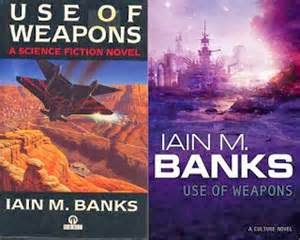
One familiar sf scenario is a decades-long interstellar voyage with passengers in suspended animation tended either by robots or by a rotating crew. In one of the chronologically confusing chapter-long flashbacks of Use of Weapons (London, 2013), Iain M Banks relocates his protagonist, Zakalwe, as a passenger and temporary crew member on such a voyage. This is another interesting change of scene but I am having trouble pulling the whole narrative together.

Another crew member tells Zakalwe a story. Because his people discussed the question of the soul so much, a philosopher king ordered a global debate after which he withdrew to think, then published two books, one endlessly repeating, "Souls do exist. Souls do not exist," the other endlessly repeating, "Souls do not exist. Souls do exist." (p. 356)

This might be considered either amusing or profound but I saw it as both wasteful and insulting to religious believers, philosophers and psychologists. Banks could better have spent those two pages summarizing the history of the subject, starting with people inferring a soul from the experience of apparently leaving the body while dreaming. I commend the Buddhist anatta teaching but am interested to hear reasoned expressions of other theories or beliefs.

Winning A War

In Use Of Weapons, it is a thing of beauty when Zakalwe takes charge of a war run by incompetents and turns it around. A province with a dozen important religious sites is about to fall. Defending the province will only get the sites damaged or destroyed whereas surrendering the province now means that they will be regained intact with much new treasure when the war is won.

Surrendering the province will also stretch the enemy's supply lines while the rains start behind them. Enemy commanders will know that the surrendered province is a trap but will be ordered in anyway, which will demoralize them. Also, by stopping the bombardment of roads, Zakalwe ensures that the roads will fill with refugees, slowing enemy troops further. But bombing some bridges and the enemies' oil refineries will make their commanders advance more cautiously even if, as believed, they have great reserves of fuel. In any case, Zakalwe distrusts his side's intelligence about enemy fuel and thinks that the enemy are equally uninformed.

When the enemy Imperial Court and their high command meet, Zakalwe proposes dropping an otherwise defunct and useless spacecraft on them, pretending that it is the first in a series of new missiles, then offering to negotiate with the commoner's parliament while the enemy are riven by civil war.

One man turns everything round - but then is told that larger scale politics require his side to lose.

Sunday, 2 March 2014

The Artificial Intelligence Question In Use Of Weapons

An artificial intelligence addresses a human being:

"'Your brain is made up of matter...organized into information-handling, processing and storage units...'"
- Iain M Banks, Use Of Weapons (London, 2013), p. 279.

The AI lists three factors that have organized the matter of the brain in this way:

genetic inheritance;
biochemistry;
experiences since before birth.

The AI asks:

"'An electronic computer is also made up of matter, but organized differently; what is there so magical about the huge, slow cells of the animal brain that they can claim themselves to be conscious...?'" (ibid.)

Nothing magical but we are in fact conscious. Otherwise, we would be unable to "claim" anything. Also, the term, "'...experiences...,'" entails consciousness.

"'...but would deny a more finely-grained device of equivalent power...a similar distinction?'" (ibid.)

Many devices made of organized matter are not conscious. However, if "'...of equivalent power...'" means "...that performs exactly the same functions...," then, yes, this electronic computer is conscious.

There is a verbal ambiguity here because previously the term "electronic computer" applied to artifacts that merely manipulated symbols without any knowledge of their meanings and therefore were not conscious. Thus, a biological organ that merely handled, processed and stored "information" could conceivably be an unconscious organic computer rather than a conscious brain. The information stored in a book or library is not conscious. An intelligent conscious being is any entity, organic or artificial, that is capable not merely of scanning and copying texts but of reading and understanding them. "Understanding," like "experience," entails consciousness.

Before asking its question, the AI had said:

"'Forget...about how machine brains are actually put together...'" (p. 278)

But how they are put together matters. Surely that determines whether or not they can be conscious? The phrase "'...machine brains...'" is ambiguous. If it means "machines that duplicate the functions of brains," then these machines are conscious whereas if it means "machines that simulate the functions of brains," then such machines are not conscious.

The AI continues:

"'...think about making a machine brain - an electronic computer - in the image of a human one.'" (ibid.)

Any artifact that is exactly modeled on a human brain so that it perfectly reproduces the functioning of such a brain will, by definition, be conscious in the way that a human brain is but will not be what used to be called "an electronic computer."

The AI suggests this process:

"'...start with a few cells, as the human embryo does'" (ibid.);
let these multiply and connect;
add new components;
make connections "'...identical...'" (ibid.) with those of the stages of human development;
in order exactly to duplicate human development, limit the speed of transmissions along the connections;
have "'...these neuron-like components...'" (ibid.) fire messages in response to signals received;
thus, exactly mimic the development of a human brain ("mimic" is ambiguous between simulation and duplication);
also mimic its output by sending signals similar to sound, touch and light as experienced inside the womb (surely this is further input, not "output"?);
simulate birth;
apply sensory stimulation so that the device thinks that it is "'...feeling, touching, tasting, smelling, hearing, and seeing everything your real human was...'" (p. 279).

At the end of this process, the AI suggests that the device can be given "'...just as much genuine sensory input, and of the same quality, as the human personality was experiencing at any given point.'" (ibid.)

Does "...the human personality...at any given point..." mean a particular person whose experiences will be directly transmitted into the device? I do not find this last point entirely clear but, in any case, if the device is genuinely an artificial brain that is literally experiencing sights, sounds etc, then of course it is conscious. But that is because the AI has described an exact duplication of human development. This still leaves open the question of the nature of those machine brains whose construction we were told to forget about in the first place.

Although the AI refers at one point to "outputs," its description of the developing device is of an entity that is almost entirely passive in its reception of inputs. In this respect, it appears to duplicate the development of a human embryo and infant. However, I think that organisms became conscious not merely by receiving inputs but primarily by interacting with their environments. Thus:

organisms were naturally selected for sensitivity to environmental alterations;
organismic sensitivity quantitatively increased until it was qualitatively transformed into conscious sensation;
sensation was naturally selected because pleasure and pain have survival value.

By "sensation," I mean the most elementary stage of consciousness, the transition from being hot to feeling hot. This happens because an organism approaches life-giving heat and avoids dangerous heat so that action, not mere reception, is paramount. Since "sensation" entails consciousness, the phrase "conscious sensation" is redundant but I use it to differentiate sensation from sensitivity that has not yet become conscious. A sensitive recording device is not conscious but sensitive organisms became conscious.

The AI asks:

"'...where is the difference? The brain of each being works in exactly the same way as the other; they will respond to stimuli with a greater correspondence than one finds even between monozygotic twins; but how can one still choose to call one a conscious entity, and the other merely a machine?'" (ibid.)

What is the point of spelling out that two entities are identical and then asking what is the difference between them? The question still remains how are AI's in the Culture constructed and are they conscious? Of course, Banks writes their dialogues in such a way that they clearly pass the Turing test but these books are works of fiction. We have not yet encountered such entities in reality.

What does "'...merely a machine...'" mean? So far, machines have been mechanisms designed to perform functions without being conscious of them. In a motor vehicle, consciousness is provided by the driver, not by the engine, and, when a computer merely manipulates symbols, then consciousness is provided by programmers and users, not by the computer. If, however, some other "machines" can duplicate human consciousness, then they are conscious machines, not "mere" (unconscious) machines.

Saturday, 1 March 2014

From The Earth To The Moon

I cannot take either Jules Verne's prose style or his characters seriously. Both the narrator and the characters are very precise about the technology of the cannon but very imprecise about the lunar environment. They do address the obvious point that the cannon blast should crush the occupants of the projectile.

It seems that Ardan, Barbicane and Nicholl go to the Moon to die. They have no way to return to Earth. When told that there is conclusive evidence that the Moon has no atmosphere, Ardan can reply only that there is some contrary evidence which makes it possible that there is an atmosphere but he address neither the obvious distinction between an atmosphere and a breathable atmosphere nor any other environmental factor such as temperature.

The original idea was just to fire a cannon at the Moon, not to redesign the projectile as a vehicle. Near the end, they even treble the number of passengers and take all sorts of extras, including two dogs. Verne ducks the issue of the lunar environment by having the projectile go into lunar orbit and ends with the optimism of a Terrestrial observer who is sure that the astronauts will find a way out of their predicament. When the projectile has left Earth, the narrative point of view remains Terrestrial so that, strangely, we lose direct contact with the astronauts. The idea for interplanetary communication was to write large letters in a desert and to send regular supplies in further projectiles.

I am genuinely curious as to what happens in the sequel, Round The Moon. The two projected options were either that their orbit would decay and that they would land after all or, alternatively, that they would remain in perpetual orbit. The sequal title seems to preclude the former and my understanding is that they do not land but what does happen and do they find a way either to return to Earth or to survive indefinitely in space?

Wednesday, 8 January 2014

Iain M Banks' Second Culture Novel

I did not expect the Empire to be overthrown by the end of the novel but it was certainly ripe for revolution. The Emperor asserts that the most stable societies are those ruled by the strong and the ruthless but events prove that brutal dictatorship and enforced poverty generate so much general discontent and internal conflict that, after what may be a long period of apparent impregnability, they can be toppled quite quickly. A civilization in which every citizen genuinely has an equal stake in the status quo is another matter.

In the Empire, males impregnate apices who impregnate females. Apices are dominant. How does this work? We are familiar with the idea of an Emperor controlling both an army and a harem. If we imagine the Emperor not as a male with many wives or concubines and soldiers but as an apex with many husbands, wives and soldiers, then we will have translated familiar relationships into this fictitious scenario.

The Emperor addresses a Culture citizen disparagingly as a male but, since the Culture has only two sexes, its citizens have no choice but to be either male or female - although they can change. The Emperor's attitude is typical of his blinkered society. Another high-ranking apex remarks that, unfortunately, most of the unemployed are loafers. So that is the cause of social and economic problems, is it?

Apparently, at least one of Banks' sf novels is not set in the Culture history. "Other Books by the Same Author" pages should be divided into:

by Iain Banks;
the Culture sf series by Iain M Banks;
other sf by Iain M Banks.

From what I have seen so far, each Culture novel features different characters and a different aspect of society in a different period. This alone makes it unlike any other long futuristic sf series, to my knowledge.

Iain M Banks' First Culture Novel

The point of Consider Phlebas seems to be the pointlessness of war:

an alien race is religiously imperialistic;

the usually peaceful Culture wages war against the imperialists;

the war is extremely destructive of lives and of technological wealth - a massive, artificial, orbiting habitat is evacuated and destroyed;

the viewpoint character is on what should clearly be seen as the wrong side;

characters who are supposed to be on the same side fight because of misunderstanding and rigid thought processes;

the war is unresolved by the end of the novel;

the second novel opens several centuries after the war and focuses on an entirely different aspect of the Culture.

Tuesday, 7 January 2014

Iain M Banks' First Two Culture Novels

A game plays a major role in the first novel and the second is all about gaming. Is it valid to make games so important in the stories without telling the reader any of the rules of these games? Despite not doing this, Banks does convey what it feels like to engage in gaming.

The Culture is a sustained presentation of a wealthy, high tech, easy-going, interstellar civilization whereas the Empire in the second novel is systematically more callous than any human society.

There is a fascinating ecology on the planet Echronedal:

oceans at the poles;
land around the equator;
a fire that moves permanently around the land;
organisms that have adapted to survive and thrive in these conditions;
an Empire that considers it appropriate to game in fire-proof castles on the surface.

I cannot help thinking that "hard sf" staples like hyperspace are really not sf but fantasy, especially when human beings from the Milky Way galaxy encounter in the Lesser Magellanic Cloud beautiful women with whom they can have sex.