Wednesday, 24 February 2016

Nuclear Warfare In Science Fiction

 Novels involving nuclear warfare:

The World Set Free by HG Wells;
On The Beach by Nevil Shute;
Ape And Essence by Aldous Huxley;
Fahrenheit 451 and The Martian Chronicles by Ray Bradbury;
Twilight World by Poul Anderson (see here).

In CS Lewis' The Hideous Strength, first published in 1945, World Wars I and II "'...were simply the first two of the sixteen major wars which are scheduled to take place in this century.'"
-Lewis, That Hideous Strength (London, 1955), p. 157.

Robert Heinlein predicted "Mutual Assured Destruction" in "Solution Unsatisfactory" and described free men continuing to fight after a nuclear war in "Free Men."

In Isaac Asimov's future history, a far future radioactive Earth probably resulted from a near future nuclear war - although Asimov revised the history later.

In James Blish's A Case Of Conscience, populations wind up living underground in permanent city-sized nuclear air raid "Shelters," even though nuclear war is avoided.

In Jerry Pournelle's CoDominium future history, the Great Patriotic Wars of 2103 end the CoDominium and are followed by the Exodus of the Fleet so they sound like a delayed World War III.

In SM Stirling's Draka timeline, the three major wars of the twentieth century are not numbered but named - the Great War, the Eurasian War and the Final War.

Harry Turtledove describes Anson MacDonald (Robert Heinlein) fighting on after Stirling's Final War.

In Alan Moore's V For Vendetta, "England prevails" under fascist rule after opting out of a nuclear exchange whereas, in the same author's Watchmen, a faked inter-dimensional invasion prevents a nuclear war.

Saturday, 16 May 2015

Imagine

Imagine -

I am in a coma from midnight to midnight. My brain is attached to a technology that focuses on the mind of an acquaintance who lives across town. During that twenty four hour period, every mental process that occurs in her brain is transmitted to mine in real time. Thus, I am effectively in a virtual reality where I experience all her thoughts, memories, imaginings, actions, conversations, even dreams during the periods when she is asleep, and I think that I am her. When I emerge from the coma, I remember my previous life as before but my most recent memories are of her previous day because I have directly experienced it.

If done without her knowledge, a total invasion of privacy. Also voyeuristic and distasteful? I further imagine that at some times during the day she has remembered and thought about me. Thus, I now have direct knowledge of how I appear to someone else. Potentially devastating. If someone else did this during a day when I met the subject and then transferred the experience to me, then I would now have both my memories and the subject's memories of a conversation between us.

Has anyone used precisely this idea in an sf story or novel? It would seem to have considerable potential. If the mental transfers were conducted with the knowledge and consent of the subject, then they would be a way for people to share experiences and to deepen understanding.

Translations

In Iron Council (London, 2004), China Mieville disguises Marxist terminology:

"'You can kiss good-bye to philosophizing. We ain't interested in the toil concept of worth, or graphs of the swag-slump tendency and whatnot. With Double-R it's just more and more notions.'" (p. 80)

- translates as:

"You can kiss good-bye to theorizing. We ain't interested in the labor theory of value, or graphs of the boom-slump cycle and whatnot. With [an agitational newspaper] it's just more and more ideas."

Mieville also quotes: "'...don't mourn organise...'" (p. 93), although the reader might not recognize this phrase as a quotation.

Later, he evokes whether deliberately or not, a comic book character: "...Remade to swamp things, amphibian." (p. 140)

Lastly, for now, one of Mieville's many bizarre creations, the Weavers (p. 194), reminds me of similar creatures in Mike Carey's Lucifer.

Sunday, 29 March 2015

Comparisons


Works of fiction resemble each other either because one influenced the other or because they address common themes. In HG Wells' works: 

the Time Traveller finds Morlocks and Eloi in 802,701 AD;
Cavor and Bedford find Selenites in the Moon;
Martians invade Earth. 

Thus, time travel, travel to the Moon and alien invasion of Earth occur in separate works. 

In Edgar Rice Burroughs' (ERB's) works:

John Carter finds green and red Martians on Mars;
Carter's successors find Kalkars in the Moon;
Kalkars invade Earth.

Thus, astral travel to Mars, travel to the Moon and alien invasion of Earth occur in successive works. In fact, ERB connected all his series and incorporated time travel:

in The Eternal Savage, someone traveling to Africa to visit Tarzan accidentally travels into the far past instead;
Tarzan visits the Earth's Core;
Gridley's radio contacts the Earth's Core and Carter's Mars;
the first Venus book refers to the events of Tarzan at the Earth's Core;
the Moon Trilogy is a sequel to the Martian series;
astral travel takes a later character to an extra-solar planet.

In ERB's inhabited Solar System, human beings are found inside the Moon and on Venus, Mars, a Martian moon and Jupiter and are said to exist on Mercury. They even exist also on the extra-solar planet.

Wells started to connect his works, then abandoned the idea. Martians:

observe Earth in "The Crystal Egg";
invade Earth in The War of the Worlds;
were mentioned in an early edition of The Sleeper Wakes
which is set in the same future society as "A Dream of Armageddon" and "A Story of the Days to Come",
the latter a sequel to "A Story of the Stone Age". 

That is it for Wellsian interconnections. When the reference to Martians was removed from The Sleeper Wakes, the main link was severed. Wells had started to move towards an inhabited Solar System. There were Selenites and Martians and the latter also invaded Venus.

ERB had dinosaurs on an island called the Land that Time Forgot during a War.
DC Comics had the War that Time Forgot on Dinosaur Island. 

In the DC Multiverse, different times and places intersected during the climactic Crisis on Infinite Earths.
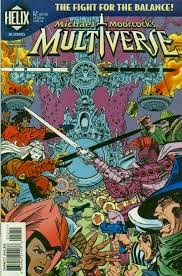
In Michael Moorcock's Multiverse, different times and places intersect during the periodic Conjunction of the Million Spheres.

Moorcock's Multiverse contains an ERBian pastiche which uses the idea of travel to the far past to explain how a twentieth century character can visit a humanly inhabited Mars. Thus, Moorcock creatively combines ideas that ERB had treated separately. Two other writers of Martian adventures should be mentioned: Edwin Arnold as a possible source for ERB and Otis Adelbert Kline as the imitator and competitor who obliged ERB to retaliate by starting a Venus series.

In the Dan Dare comic strip:

Dare found Treens and Therons on Venus;
Treens invaded Earth which they ruled through robots
until Cadet Spry seized the mike and, imitating the Mekon, ordered the robots to attack the Treens,
thus forcing the Treens to destroy the robots. 

In the Dr Who TV series:

the Doctor found Daleks and Thals on Skaro;
Daleks invaded Earth which they ruled through robotised men
until the Doctor's granddaughter seized the mike and, imitating a Dalek, ordered the robomen to attack the Daleks,
thus forcing the Daleks to destroy the robomen.

The Daleks-Thals and Daleks Invasion Earth stories were adapted as feature films starring Peter Cushing not as a Time Lord called the Doctor but as an English inventor called Doctor Who, thus closer to the Wellsian original. The originals of the Doctor and his assistants contending with Daleks, robomen, cybermen etc are the Time Traveller and Weena contending with Morlocks, then the Time Traveller alone contending with giant crabs and the end of life on Earth.

Daleks, like Wellsian Martians, are evolved beings inside protective machines. John Christopher acknowledged that he had unconsciously plagiarised Wells when he wrote about extra-solar invaders in tripods.

Wells, ERB, Moorcock, DC Comics, Dan Dare and Dr Who: this summarises a lifetime of appreciating imaginative fiction. In the above summaries, Earth is invaded from Mars, the Moon, Venus and two extra-solar planets. Some similarities are acknowledged influences. Others are sources of wonder.    


Thursday, 25 September 2014

Planet Of The Apes

A novel.
A series of five feature films.
Novelizations of the four original films.
A live action TV series.
A prose adaptation of TV episodes.
A TV "Annual" book.
A record.
An animated TV series.
A Marvel Comics adaptation of the first film.
A real bad Marvel Comics on-going series.
A one-off feature film.
A new series of, so far, two feature films.

In the first film series, a chimpanzee couple featured in the first three episodes and their son, Caesar, was the hero of the remaining episodes. The name "Caesar" is retained for the hero of the new series.

The double surprise ending of the novel was, first, that, while the astronauts had been on Soror, apes had become intelligent and had taken over on Earth and, secondly, that the apes later had space travel.

The surprise ending of the first film was that the Planet of the Apes visited by the astronauts was in fact Earth after a nuclear war. The surprise ending of the second film was that a belatedly detonated doomsday bomb destroys Earth. The surprise beginning of the third film was that a chimpanzee couple time traveled to present day Earth. The surprise ending of the third film was that that couple become ancestors of the intelligent apes that later dominate Earth. The fourth and fifth films show the human-simian conflict that leads to an ape-dominated Earth.

Thus, in the novel and the first film, space travel transported characters to the ape-dominated planet. At the mid-point of the film series, time travel was introduced to keep the series going and a time travel paradox was used to explain the series. The new series dispenses with space travel and time travel and moves directly to a different version of the human-simian conflict that leads to an ape-dominated Earth.

Addendum, 26 Sept 2014: Human-simian conflict is covered in a journal in the original novel. Amazon has some more recent books that I am unfamiliar with.

Monday, 25 August 2014

Dates Of Future Past

1984 is a novel.
2000 AD is a comic.
2001 is a film.
Year 2018! is an alternative title of They Shall Have Stars, Volume I of James Blish's Cities In Flight future history.
Revolt In 2100 is Volume III of Robert Heinlein's Future History.

A Case Of Conscience, Volume III of James Blish's After Such Knowledge Trilogy, is set in 2049-'50.

Having lived from 1949 until, so far, 2014, I hope to live until the years of the two Blish novels.

Saturday, 23 August 2014

Lines Of Development

In the 1960's and early '70's, I read as much science fiction (sf) as I could find. Thus, I became very familiar with the works of certain authors. I caught up with Clifford Simak and read his then newly published The Goblin Reservation but did not continue to buy new works by Simak partly because I thought that he had become repetitive and self-parodying and partly because I was by then less interested in reading new sf.

I know of only a single work by Ward Moore, Bring The Jubilee, and have read only a single work by Tim Powers, The Anubis Gates. In both these cases, the common topic of interest is time travel.

The following lists are not intended to be exhaustive but they do represent what I regard as certain major lines of development among the sf writers that I have read:

British
Wells
Stapledon
Lewis
Aldiss

American
Burroughs
Heinlein
Asimov
Blish
Bradbury
Anderson
Niven
Pournelle

Wells and Heinlein are two starting points. Sf readers will notice that many prominent names are absent, often because they started to write long after I had ceased to read. I have appreciated rereading the works of several of the listed authors. Because Poul Anderson uniquely combines quality with quantity, he has become the subject of a blog. Because of Greg Bear's connections with Anderson, I have this month started to read, and post about, Bear's Way Trilogy.