Saturday, 25 July 2026

Mars Books

SM Stirling, The Sky People (New York, 2007).

An sf writer called Bob had had an idea for another Mars book about a human orphan adapted by Martians but that will not now be written. His earlier book had involved oxygen masks and skating on the canals. 

What is a "Mars book"?

Red Planet is set on Mars.

War Of The Worlds is set on Earth because it is about Martians invading Earth.

Stranger In A Strange Land is set on Earth because it is about that orphan "returning" to his parents' home planet.

Red Planet and Stranger... have the same Martians.

A book can be about Mars, Martians or both.

Sunday, 31 December 2023

Multi-Layered Narratives

In The Van Rijn Method:

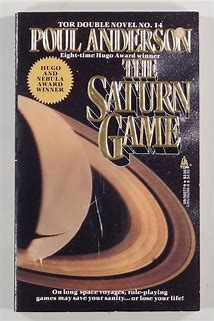
Francis L. Minamoto introduces "The Saturn Game";

Hloch introduces seven stories that had previously been collected in The Earth Book of Stormgate;

Vance Hall and Noah Arkwright, respectively, introduce two stories that had previously been collected in The Trouble Twisters;

Le Matelot introduces one story that had previously been collected in Trader To The Stars.

Hloch informs us about the fictional authors of the Earth Book works. Thus, a daughter of the hero of "Esau" wrote both "Esau" and "The Season of Forgiveness" and both these stories had been published in the Avalonian periodical, Morgana, before Hloch collected them in the Earth Book. The main action of "Esau" is framed by a conversation between its hero and Nicholas van Rijn. Thus, throughout The Van Rijn Method, we experience multiple layers of narrative and historiography. In the case of "Esau":

Emil Dalmady in action
Dalmady in conversation with van Rijn
Judith Dalmady/Lundgren writing for Morgana
Hloch compiling the Earth Book

Or again, in the case of "The Problem of Pain":

Peter Berg on Gray/Avalon
the unnamed narrator in conversation with Berg
that narrator in private correspondence on Earth
a historian obtaining a copy of the correspondence
a transcription kept on Esperance
Hloch's mother, Rennhi, finding the transcription
Hloch explaining all this to his Avalonian readers 

Crossing A Threshold

Three continuing characters, Nicholas van Rijn, David Falkayn and Adzel, are distributed across seven of the eleven instalments collected in The Technic Civilization Saga, Volume I, The Van Rijn Method. However, these three characters do not co-appear in a single narrative until the second of the seven instalments collected in Volume II, David Falkayn: Star Trader. All three make their final appearances in the first of the six instalments collected in Volume III, Rise of the Terran Empire. Whether singly or together, these three characters  are featured in fourteen of the twenty-four instalments collected in Volumes I-III. Of the remaining ten instalments, three are pre-Polesotechnic League whereas five are post-League. Thus, these three (of seven) volumes in themselves present a future history series, i.e., a futuristic sf series covering a period longer than the lifetimes of any individual characters.

The very first Technic History instalment, "The Saturn Game," links the late twentieth century of the author, Poul Anderson, to the fictional future of the series. 

"The fact is that thresholds exist throughout reality, and that things on their far sides are altogether different from things on their hither sides. The Chronos crossed more than an abyss, it crossed a threshold of human experience.
"-Francis L. Minamoto, Death Under Saturn: A Dissenting View (Apollo University Communications, Leyburg, Luna, 2057)"
-Poul Anderson, "The Saturn Game" IN Anderson, The Van Rijn Method (Riverdale, NY, December 2009), pp. 1-73 AT I, p. 1.

One threshold is between reality and fiction. The characters in this fictional narrative cross the threshold between single-level activity and role play, then go further into the role play than anyone has done before, crossing another threshold. 

A threshold with altogether different things on its hither and far sides is what the philosopher, Hegel, called the "specific quantum." Thus, a liquid becomes solid below its freezing point and gas above its boiling point. These two points are specific quanta where a quantitative increase or decrease suddenly becomes a qualitative transformation. Another example is the straw that broke the camel's back. The most significant qualitative difference is that between empirically detectable neural interactions and subjectively experienced mental states.

"The Saturn Game" links back to the mass entertainment of the twentieth century and shows a plausible, or at least possible, programme of Solar System exploration in the near future. We might imagine that this near future does not after all lead to the Technic History. However, it does contain one precursor of later developments, the Jerusalem Catholic Church. Everything connects although there is no direct connection between "The Saturn Game" and the very last Technic History instalment, "Starfog." Both stories are about the exploration of space but in different millennia and in different spiral arms of the galaxy. More thresholds have been crossed, the most important being from slower-than-light space travel to faster-than-light.

Friday, 29 October 2021

The Universal Soldier

An idea for an sf novel:

a very long novel with many short chapters (could be endlessly serialized in magazines before eventual book publication);

each chapter shows the protagonist in combat in a major war, starting in prehistory, passing through many historical periods and the present and into the future which also has many dissimilar periods, e.g., war on Earth in the twenty-fourth century is very different from war on Mars in the twenty-sixth century;

no up-front explanation of why this guy is alive in all these periods (think of John Carter, always a soldier, remembering no childhood);


his name changes appropriately, i.e., Joannes becomes Johan, Jan, Jean, John, Sean etc;

some ambiguity as to whether he is killed at the end of some of the chapters, e.g., is he killed in an explosion or just concealed by smoke?;

maybe a future period of global peace when our protagonist does not seem to exist?;

a further future in which a Time Travel Institute plans to send a man to experience combat in many past periods;

if killed, he can be retrieved, resurrected and sent back.

Sunday, 29 September 2019

Heinlein And Anderson: A Brief Comparison

Heinlein's Future History and the first of Anderson's several future histories could each be collected in two omnibus volumes. See here.

Each wrote three circular causality narratives. However, Anderson also wrote a time travel series that is complete in two long volumes and enough time travel short stories for a further collection.

Heinlein wrote more juvenile sf but Anderson wrote in several genres.

Heinlein's writing deteriorated badly whereas Anderson's remained creative and innovative into the twenty first century.

Monday, 31 December 2018

Lignin Degrader

Julian May, Intervention, 12.

Sf covers every kind of scientific advance, not just spaceships, aircars or superior weapons. James Blish's They Shall Have Stars goes into technical details about the discovery of anti-gravity and of antiagathic drugs. In Intervention:

"One of my nephew's underhanded acquisitions was a small genetic-engineering firm in Burlington, Vermont. This outfit had perfected and patented a bacterial organism called a lignin degrader, that broke down (i.e., 'ate') a common waste product of the pulpwood industry, converting it into a host of valuable chemicals that had heretofore been obtained from increasingly scarce petroleum." (p. 507)

Technology involves economics which involves business (and other) arrangements between human beings. Thus, the narrator's nephew, needing additional capitalization, approaches an even bigger crook to proposed a merger sealed by two Mafia-style arranged marriages.

An sf novelist combines scientific speculations with character interactions. 

The Disintegartion Of The Soviet Union

"In those dark days, when even persons of goodwill were soul-burdened with the malign aetheric resonances of hatred, fear and suffering, there were many people in the United States who watched the disintegration of the Soviet Union with righteous triumphalism: the godless Commies had finally got what was coming to them."
-Julian May, Intervention (London, 1988), 17, p. 549.

Intervention is copyright Julian May 1987. Chapter 17 is set in 2007.

Robert Heinlein had the first rocket to the Moon in 1978 as far as I can remember without going upstairs to check. Fortunately, World War III did not happen in the twentieth century but all those weapons still exist. Current affairs and future histories interpenetrate.

Catholicisms

Contrast the medieval Catholicism of Poul Anderson's The High Crusade (see here) with the modern and future Catholicism of Julian May's Pliocene/Intervention/Galactic series.

Denis Remillard, while confessing to a Jesuit priest in 1995, mentions that he values highly the opinions of two colleagues, a Neo-Marxist and a Tibetan lama turned idealistic humanist. The priest comments that, in both of those faiths, the good of society is paramount over that of the individual whereas Christianity and Western civilization give the individual sovereignty in reproductive matters, which is the issue that they are discussing. Thus, a reasoned exchange between alternative world views is possible.

Later in May's series, a woman Jesuit priest officiates at a same sex marriage. That will not happen in our timeline.

Sunday, 30 December 2018

The St. Francis Hotel In Two Timelines

"The speech ended to applause and the split screen showed pan shots as the network cameras swept over Baumgartner's campaign workers, who packed the ballroom of the famous old St Francis Hotel."
-Julian May, Intervention (London, 1988), 9, p. 474.

"They met downtown next morning, in the anachronistic opulence of the St. Francis Hotel lobby."
-Poul Anderson, The Shield Of Time (New York, 1991), PART SIX, 1990 A.D., p. 430.

Baumgartner's campaign is in 1996 but these are different timelines.

For earlier blog references to the St. Francis Hotel, see here.

Thursday, 1 November 2018

Four More Future Histories

Back To Methuselah by George Bernard Shaw.
The Galactic Center Saga by Gregory Benford.
A Short History of the Future by W. Warren Wagar.
The Third Millennium: A History Of The World: AD 2000-3000 by Brian Stableford and David Langford.

OK. I read Back To Methuselah once decades ago, have read perhaps two Galactic Center volumes and had not heard of the other two works until they appeared on recent Internet searches.

Blog readers will see that I have not kept up with contemporary sf and are invited to comment to that effect.

Wednesday, 31 October 2018

Future Histories II

Although it is interesting to compare future histories, I focus more on some than on others.

According to RC Churchill's A Short History Of The Future, Kurt Vonnegut's Player Piano, Ray Bradbury's Fahrenheit 451 and The Martian Chronicles and George Orwell's 1984 are contemporaneous, then the nuclear war at the end of the two Bradbury works is followed by Aldous Huxley's Ape And Essence (not his Brave New World) and later by several other authors' narratives set in successive future periods.

I have read Churchill's book but do not possess a copy. It might be possible to find more information about its contents on the Internet. One of Churchill's discoveries was that the future is very different from the past, containing as it does many arbitrary and alarming events. 1949 was a turning point year and is also the year in which I was born.

Googling reveals that there are more recent relevant works that I am unfamiliar with.See Four More Future Histories.

Future Histories

British
Wells, The Shape Of Things To Come
Stapledon, Last And First Men
Aldiss, Galaxies Like Grains Of Sand
RC Churchill, A Short History Of The Future

American
Burroughs, The Moon Trilogy
Heinlein, The Future History
Asimov, Robots and Empire
Blish, three including one that branches
Anderson, eight or nine
Niven, Known Space
Pournelle, CoDominium
Piper, Terrohuman
Bradley, Darkover
Simak, City
Le Guin, Hainish
Cordwainer Smith, The Instrumentality

Tuesday, 30 October 2018

First Man On The Moon

A one volume collection of "first man on the moon" short stories - or at least shorter than novels? Contents?

"The Man Who Sold The Moon" by Robert Heinlein.
"Forms Of Things Unknown" by CS Lewis.
"The Light" by Poul Anderson.
"Wrong Way Street" by Larry Niven.

What else?

Monday, 2 July 2018

A Few Fragments

Some phrases do not become even proto-stories but remain forever fragments:

In 4019, the Mutant led his fleet into the Solar System...

Two feet behind and above us on the spaceship bridge stood the Absolute Dictator of Earth...

The Patrol asked me to survey the Morecambe Bay Area, 2000-2050: a complicated passage back and forth through both time and space. Usually disguised, I would not have recognized my older selves. Once, early in the survey but near the end of the period, I did recognize my undisguised future self and my ex, looking happy together...

The Very First Draft Of A Science Fiction Story

"You And I"

You were unemployed in '25 and the Benefits Office put you on an Employment: Special Projects training scheme in a former agricultural college in Kent: endless psychometric tests, cybertraining, subliminal audiovisual inputs, sleep learning, EEG scans and semi-military discipline. Your class knew that some candidates would be selected for higher level training but did not know for what. Because of the continuing emergency, security was tight.

The psychological side-effects were intense. Complete strangers became close friends very quickly but there were also inexplicable polarizations. The sounds of the discos that you did not attend seemed to echo in your room. The Happy Clappers and Stampers met in the room above yours. You heard, almost felt, their initiation ceremonies and conversion experiences, then something else, a warning, like a still small voice: Leave now before the next scan.

While signing for your weekend pass, you knew exactly what the uniformed perimeter guard thought of you as he looked you up and down: These unemployable dissident intellectuals!

In London, you went underground and contacted what was left of the Organization. They faked your ID and helped you to fly to Kapustin Yar where the Russian ESP program is located, where I, the first Russian telepath, wait.

Thursday, 28 June 2018

Time And (Sex In) Space

Time
In an unfinished novel, "The Dark Tower," CS Lewis argues that physical time travel is impossible and then presents mental transference between timelines.

In two stories and one novel, Robert Heinlein presents three classic statements of the circular causality paradox.

In many stories and novels, Poul Anderson addresses every aspect of time travel.

(Sex In) Space
In Heinlein's " - All You Zombies -," the time traveler changes sex and is both his own parents. While female, she joins the:

"'Women's Emergency National Corps, Hospitality & Entertainment Section...'"
-Robert Heinlein, " - All You Zombies - " IN Heinlein, The Unpleasant Profession Of Jonathan Hoag (London, 1980), pp. 126-137 AT p. 128 -

- known in other periods as:

"'Auxiliary Nursing Group, Extraterrestrial LegionS'..."
-ibid. -

and:

"Women's Hospitality Order Refortifying & Encouraging Spacemen..."
-ibid.

Heinlein makes the same points as Lewis in "Ministering Angels":

it is recognized that men sent into space for extended periods will need a release of tension;
"'But most volunteers were old hookers...'" (ibid.)

By the time of Anderson's Young Flandry Trilogy, space travel is no longer difficult or dangerous so that more acceptable young women can be sent to extrasolar Naval bases.

Wednesday, 28 February 2018

Cosmic Dawn

https://www.theguardian.com/science/2018/feb/28/cosmic-dawn-astronomers-detect-signals-from-first-stars-in-the-universe

My daughter emailed me the above link.

Writers of cosmological sf, including Poul Anderson, have incorporated stellar evolution into the plots of novels. It seems that physicists have now detected the very beginning of that evolution. Cosmic Dawn would make a good title for an sf novel although the phrase has already been used for at least two works of non-fiction. See the attached images.

I have no idea how the new discoveries can be incorporated into fiction but then I would not have been able to write The Avatar or Tau Zero either. Both of these novels by Poul Anderson describe a cosmic journey and the beginning of a universe. The journeys are by T-machines and time dilation, respectively. The time dilation occurs in an accelerating Bussard ramjet. Neither of these novels invokes "hyperspace" although Anderson also imagined different versions of that. His future history series, the History of Technic Civilization, addresses the rise and fall of civilizations against the backdrop of galaxies, spiral arms, pulsars and supernovae. Hopefully, Anderson's many successors can meet the challenge of the Cosmic Dawn.

Sunday, 31 December 2017

Science Fiction, Swords And The Supernatural

Science fiction is an extremely broad category. I have just read the concluding section of Prince Of Outcasts by SM Stirling. Soldiers fight with swords and the supernatural is manifested so is this sf? Yes. The story is set in the future. The premise of the series is that advanced technology has stopped working, therefore warfare has returned to swords. The supernatural is a transcosmic consciousness that had emerged from a previous cosmos and has caused the Change. Thus, every feature of the plot is scientifically rationalized although several volumes read like fantasy. The companion series, about the temporally displaced Nantucket, is time travel sf without any supernatural manifestations beyond the as yet unexplained Change/Event. The premise of divergent timelines allows for any number of coexisting scenarios as demonstrated in other novels and series by Stirling. Sf as a literary ghetto developed various stereotypes and cliches but is always able to transcend them.

Saturday, 30 December 2017

A-Mortality

According to Yuval Noah Harari, Sapiens: A Brief History of Humankind (London, 2014), human agelessness and post-organic intelligences may be imminent.

In Poul Anderson's sf:

aging is ended in World Without Stars and in The Boat Of A Million Years;

post-organic intelligences coexist with human beings in the Harvest of Stars Tetralogy and supersede humanity in Genesis.

I have referred to Anderson's ageless characters, Hugh Valland and Hanno, as "immortal" although they are not immune to either accident or violence. See Two Unaging Men. Harari contributes appropriate terminology:

"A few serious scholars suggest that by 2050, some humans will become a-mortal (not immortal, because they could still die of some accident, but a-mortal, meaning that in the absence of fatal trauma their lives could be extended indefinitely.)" (p. 301)

I think that John W. Campbell said, "The first immortal man has already been born." By googling, I found similar claims. See here.

See also Hanno, Lazarus Long And John Carter.

Monday, 31 July 2017

Myth Meets Economics

SM Stirling, The Tears Of The Sun (New York, 2012) is an fsf mix so it is appropriate to discuss it on an sf blog. There are gods but they are scientifically rationalized. Mind, sometimes manifesting as gods, evolved in an earlier universe and now transforms new universes from their beginnings. (Norse gods originated in a precosmic void so the origin of Stirling's gods is legitimate.)

Let's look at history in our universe before we get into Stirling's fiction. Why were kings powerful?

Mythological answer: because they were descended from and appointed by gods.

Economic answer: because social labour had produced a surplus that maintained, and was controlled by, a ruling class.

My response: appreciate the mythology and understand the economics.

In Stirling's fiction:

high technology stopped working in the Change;
economies retrogressed to cannibal, tribal, feudal etc;
many populations have taken refuge in diverse mythologies;
and beings answering the descriptions of gods, saints and demons have become active both in the Change and in the subsequent course of events.

Now, in this context:

"The Destined Prince with the Magic Sword is wonderful, but less wonderful when he asks you to cough up every tenth bushel and piglet and takes out a mortgage on your farm." (Chapter Fifteen, p. 463)

Myth meets economics. A divinely appointed High King must raise taxes to wage expensive wars against demonolaters. Why can't the gods be more helpful by making him financially independent, e.g., with a secretly located, privately owned gold mine?